A Florentine who is not a merchant—who has not traveled through the world, seeing foreign nations and peoples and then returned to Florence with some wealth—is a man who enjoys no esteem whatsoever. — Goro Dati, History of Florence (c. 1405)
Table of Contents
- The Author and his World
- Florence at the Turn of the Fifteenth Century
- An Economic Powerhouse, but Unstable
- From Republican City-State to Territorial Power
- Cultural Patronage: Beyond the “Big Three” (Dante, Petrarch, and Boccaccio)
- The Life and Times of Goro Dati
- Mediterranean Ambitions
- What about Leonardo?
- Florence at the Turn of the Fifteenth Century
- Models and Influences
- Merchants' Manuals
- Literary Influences
- Dati and Dante
- Cosmology and Astronomy
- The Human Body and the Humors
- The Manuscripts
- The Diagrams
- The Illustrations
- Geography and Mapping
- The Manuscript Tradition
- Dati’s Language
The Globe, really? In 1425?
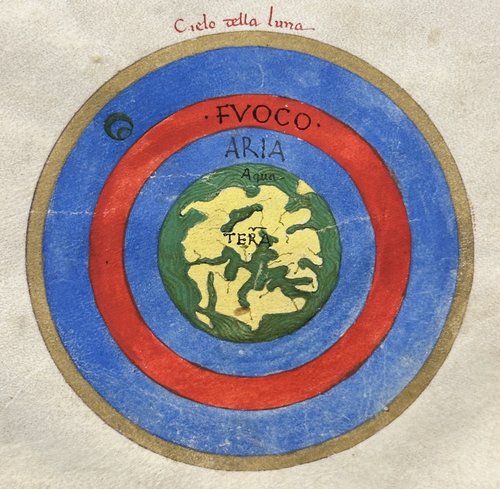
Yes! One of the most persistent misconceptions about the Middle Ages is the idea that people before Christopher Columbus thought the world was flat—a claim popularized only in the 19th century by American novelist Washington Irving. In fact, Europeans had known the world was round since the days of the ancient Greeks, and famous fifteenth-century explorers like Columbus and Prince Henry the Navigator were building on a centuries-long tradition of intercontinental travel and cultural exchange.
Gregorio Dati’s La sfera (“The Globe”), an early-fifteenth-century poetic treatise that introduces readers to the cosmos, the natural world, and Mediterranean geographies, is a superb witness to the fact that medieval cosmographers and natural philosophers had always known the earth was round. The work is divided into four books each containing thirty-six stanzas of eight poetic lines each (a meter known as ottava rima). These books are organized around four different themes:
- Book 1 focuses on cosmology, astronomy, and astrology;
- Book 2 discusses earthly natural phenomena such as humors, weather, seasons;
- Book 3 covers the mechanics of sea travel and the geography of the continents;
- and Book 4 provides an itinerary of the Mediterranean and Black Sea coastlines.
The overall structure of the poem can be read as a progression from the divine and heavenly down to the terrestrial and human; the poem begins in God’s celestial seat, the Empyrean, and ends in the Sea of Azov, the last stop of a mercantile itinerary through the entire Mediterranean. Dati’s stated goal, however, is not just to impart knowledge, but rather to provide readers with a framework to understand their place within the vastness of the cosmos and the natural world. For this reason, each book begins with an invocation to God—the divine power that gives a “natural order” (1.31) to the cosmos, and the key through which the human mind can understand every thing and being found in it, large and small.
La sfera was a bestseller in its day, with over 180 hand-copied manuscripts and seventeen early printed editions surviving from the hundred years between 1430 and 1530. This introduction provides a brief overview of La sfera, its author, and the broader world of Florentine trade in the fifteenth century, as well as the multiple intellectual and literary genres that influenced Dati’s poem. We also review the many unique surviving manuscripts of the text and patterns that emerge between them, including among the diagrams, images, and maps that accompany Dati's work.
La sfera offers a superb overview of Europeans’ sense of the world and its geography in the period before Columbus, particularly in those last few decades when middle-class Italians like Dati dominated the fifteenth-century global economy.
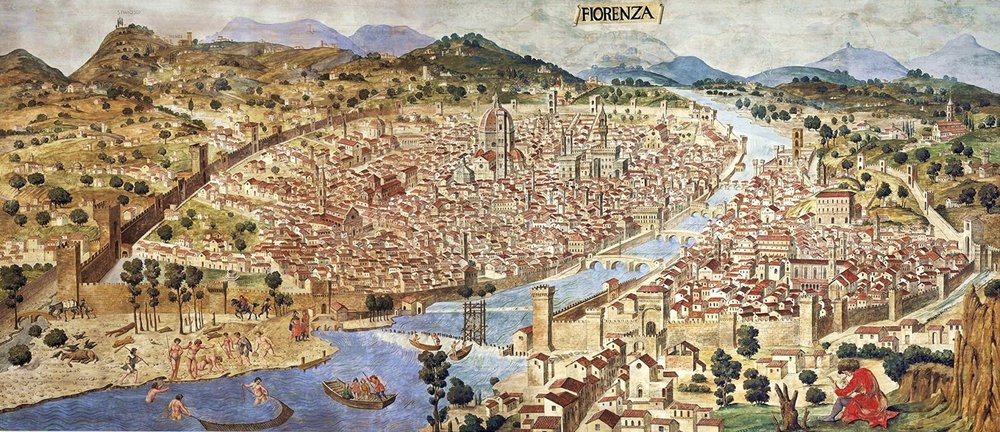
Florence at the Turn of the Fifteenth Century
From as early as the tenth century, Italian city-dwellers capitalized on Mediterranean trade—largely but not exclusively between western Europe and the eastern Mediterranean—to accumulate capital and leverage it into political independence. Italian cities consistently ranked among the largest in premodern Europe, and the populations of some—like Genoa and Venice—may have grown from fifty thousand to two hundred thousand during the medieval period.
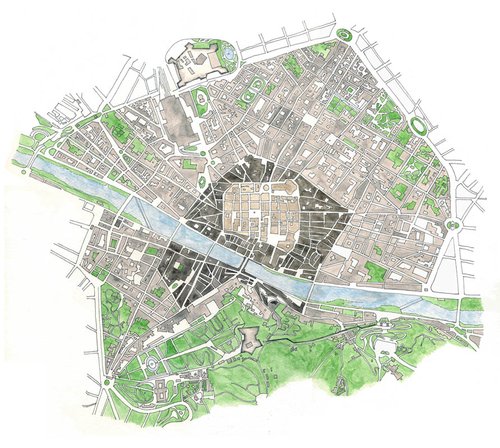
Although Florence is located inland along the River Arno, without direct access to the coast, its citizens nonetheless managed to establish themselves as leaders in the international cloth trade and later branched out into commercial exchange and banking. By the mid-fourteenth century, Florence’s newest circle of walls, built between 1284 and 1333, enclosed an area of more than five square kilometers that sheltered around one hundred thousand inhabitants—over four times the size of the earlier circuit, built in the twelfth century.
This map of Florence's urban development by artist Anna Gibb shows the original Roman city (light grey), the larger circuit of 12th-century walls (dark grey), and the much bigger circuit of 14th-century walls.
An Economic Powerhouse, but Unstable
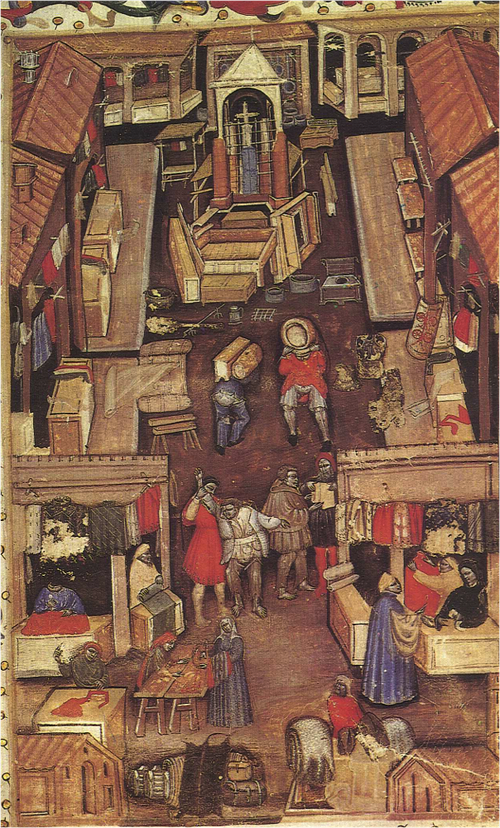
The wealth and influence afforded by this economic growth partly explain Florence’s political organization as a guild republic. The Ordinamenti di giustizia (“Ordinances of Justice”), a set of laws put in place in 1293, reserved political participation in Florence for the middle classes, with priority given to members of the seven major guilds or arti—judges and notaries, cloth merchants and bankers, money changers, silk and wool merchants, doctors and apothecaries, and fur dealers.
This governance model, which was designed to limit the political influence of the landed magnates and aristocracy, was fairly common in late medieval Italy. In the absence of strong territorial powers many northern Italian cities developed into more or less autonomous, republican city-states called communes that often controlled an extensive surrounding territory called the contado. Communes were run by small groups of elected men, with strict voting eligibility rules, multiple councils, and frequent changes of office.
While these policies ensured that no single individual or group could gain permanent control of the government, the lack of continuity encouraged conflict between rival factions and, in turn, long-term instability—famously chronicled by authors such as Dante Alighieri, Dino Compagni, and Giovanni Villani. By the late fourteenth century, many Italian communes were dominated by dynastic rulers called signori (lords), while others had been incorporated into the territories of their more successful neighbors.
By the later fifteenth century, dozens of the northern Italian communes that had successfully challenged Emperor Frederick Barbarossa’s authority in the twelfth century had been amalgamated into a patchwork of ten or twelve regional territories that included the republics of Florence, Venice, and Genoa as well as the duchies of Milan, Modena, and Ferrara.
Outlasting many of its contemporaries, the medieval Florentine republic emerged as the dominant economic power in Tuscany by the early fifteenth century despite persistent factional conflicts, uprisings such as the 1378 rebellion of the city’s cloth workers known as the Ciompi, and the devastating consequences of the Black Death, which first hit Italy in 1348 and resurfaced intermittently for decades. It became more oligarchic, however, as wealth inequality grew and political participation was increasingly restricted. Outside the city’s walls, neighboring cities such as Arezzo, Pistoia, and Pisa—once independent communes, and rivals to Florence both economically and politically—eventually came under Florence’s influence and control.
From Republican City-State to Territorial Power
The author of La sfera, therefore, lived at a key moment of transition, when the once modest medieval city-state of Florence was quickly becoming a territorial state. As markets, business practices, and maritime technology evolved, the merchants of Florence were keen to compete with their counterparts in Genoa and Venice, the cities that had traditionally dominated Mediterranean trade. At the same time, the Florentine government remained alert to potential threats to its civic independence, such as from Duke Giangaleazzo Visconti of Milan, who made a bid to subdue the city between 1390 and 1402, and King Ladislaus of Naples, who did the same between 1408 and 1414. At the same time, the republic was vulnerable to the establishment of internal bases of power: an oligarchy dominated by the Albizzi family eventually gave way to dominance by the Medici family under Cosimo il Vecchio (“the elder”). While Gregorio Dati was not (as far as we know) a direct client of the Medici family, he was nonetheless connected to many of the same people as were the Medici, making him an auxiliary connection and witness to Cosimo’s consolidation of Medici authority in Florence through the early decades of the fifteenth century.
Cultural Patronage: Beyond the “Big Three” (Dante, Petrarch, and Boccaccio)
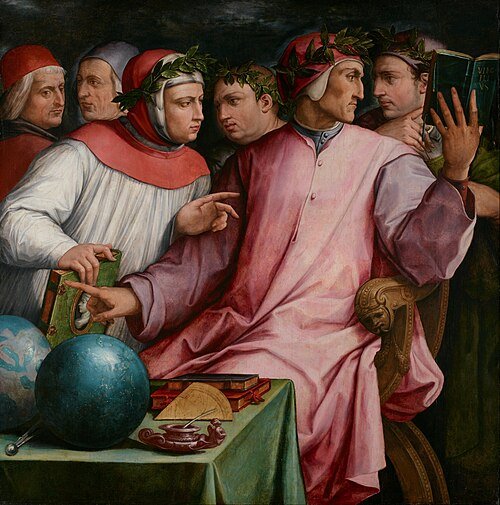
Partly because of its immense wealth and competitive social atmosphere, Florence in this period encouraged and supported many forms of cultural activity. Artists and architects created major works of art for the city while humanist scholars ran the municipal chancery. And even as humanists championed the revival of classical Latin, the city also supported a longstanding tradition of vernacular literature. The city’s greatest poet was Dante Alighieri (d. 1321), whose Divine Comedy preceded La sfera by about a century and was widely beloved in Dati’s time. Additionally, works by poets with strong ties to Florence and Tuscany who followed Dante—such as Francesco Petrarca (d. 1374) and Giovanni Boccaccio (d. 1378)—had cemented Dante’s claim that the “lowbrow” Florentine vernacular (rather than the scholarly language of Latin) could successfully treat serious matters in literary form.
Despite their undoubted success among their intended readers, however, poems like Dati’s have often been neglected by scholars because they were not believed to reach an ideal of cultural production defined by humanism, classicism, and an exclusive highly-educated elite as the main source of knowledge production. Contrary to these assumptions, many poems dealing with traditional political, religious, and narrative themes continued to be written in the Florentine vernacular in this period. Dati’s La sfera thus exemplifies concerns of its time and place not only in its content—that is, its focus on navigation and commerce—but also in its format and style, especially the vernacular verse form known as ottava rima.
The Life and Times of Goro Dati
Born in 1362, Goro followed his father Stagio into the silk trade, and by 1384 was working in partnership with the more established merchant Giovanni di Giano, conducting business largely in the Western Mediterranean, and especially along the Spanish coast: Valencia, Barcelona, and the Balearic Islands.
We know a remarkable amount about his life due to the survival of his diary, called The Secret Book, a fascinating record of the ups and downs of Dati’s personal and professional lives. From this we learn that Goro experienced various blows to his fortunes over time: he was disappointed by deals that fell through, cheated by unscrupulous partners, and robbed by pirates (in fact, his discussion of piracy at La sfera 3.4.4 may echo his personal experiences). Yet he managed to keep his business affairs afloat, especially with the assistance of the dowries that accrued to him each time he remarried. His success is suggested by the fact that each of his four wives was of a higher status than the last. They bore Dati twenty-six legitimate children in total; Dati also had an illegitimate son by an enslaved Tatar woman, Margherita, whom he had purchased in Valencia.
Despite his relatively humble beginnings, Dati played a major role in the economic and political spheres of turn-of-the-century Florence. He was chosen eleven times as consul of the silk guild, one of the nine major corporate bodies holding seats in Florence's main council, the Signoria. He served on the Florentine board of trade and was twice Gonfaloniere di compagnia (a ward officer or representative for a city district). Most prominently, he served on the highest political council in Florence as prior in 1425, and as Gonfaloniere di giustizia, or Standard-bearer of Justice, the highest single office in the republic, in 1429. Many of these offices are recorded in his Secret Book.
Mediterranean Ambitions
Dati’s forty-year political career overlaps almost exactly with the years in which the city of Florence was committed to becoming a serious Mediterranean power, which is relevant for understanding La sfera. Prior to this time, most Florentines conducted the bulk of their medieval trade indirectly: that is to say, they would trade in wool from England, silks from the East, and banking transactions going both ways by engaging non-Florentine agents such as the Genoese or even the Venetians to transport those goods.
In 1406, however, the Florentines conquered the formerly great port city of Pisa; while this gave them a foothold in maritime shipping, Pisa was still over three miles from the coast due to the silting up of the Arno river. In 1421 Florence purchased the neighboring ports of Porto Pisano and Livorno and started building their own fleet. They instituted magistrates called the Consoli del mare, the Sea Consuls, and the first Florentine galleys sailed in 1422 for Alexandria, where the Florentines arranged to transfer the Pisans’ trading privileges in Mamluk Egypt to themselves. The Florentines soon had nearly thirty ships engaged in the semi-annual trade run across to Egypt.
These were exactly the years in which Goro held progressively more prestigious political offices; further, while as far as we know he did not himself travel east with the Florentine fleets, a number of his close connections and relatives by marriage served as ambassador or admiral on those journeys. La sfera therefore reflects the authoritative voice of a major civic official who was also one of the city’s most prominent silk merchants. Even after he retired from public life following his stint as Gonfaloniere di giustizia, Dati appeared regularly as an advisor in the chief councils, until shortly before his death in 1435.
The traditional date hypothesized for the composition of La sfera, 1435, is based on the assumption that the work was left unfinished at Goro’s death. The language and structure of Book 4, however, suggest that the work as it currently exists represents the totality of what the author intended to write. As noted above, the fourth and final book of La sfera offers an itinerary of major Mediterranean ports, beginning at Gibraltar and moving counter-clockwise as far as the Black Sea. When the poem ends at the port of Tana on the Sea of Azov, Dati notes that “from where we started our trip at the beginning, this is the most remote and most foreign place that you can sail to” (4.36.5–7).
Dati’s concluding words—and the fact that La sfera is divided into four neatly balanced books of 36 stanzas each—suggest that Dati never meant to continue around the northern half of the Mediterranean. In that case there is no reason to choose 1435 as a likely date, and a date in the 1420s seems more likely based on Goro's close involvement with the Florentines' Mediterranean interests in that decade. From this perspective, La sfera can be understood as a reference manual of information critical for contemporary policy decisions, crafted in a uniquely Florentine poetic format. Its composition in the early years of the fifteenth century aligns with a keen Florentine interest in mercantile matters and the East specifically as—with Dati’s expert help—they were attempting to recalibrate their position in the larger Mediterranean world of trade.
What about Leonardo?
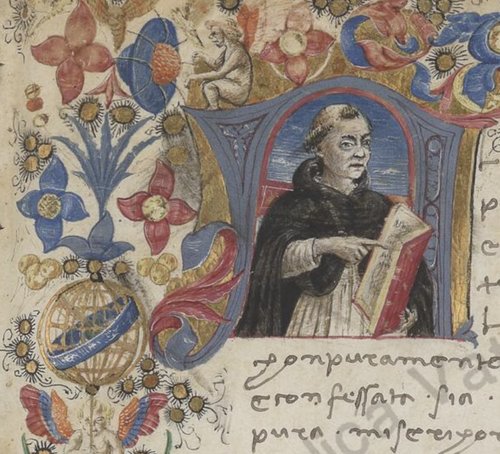
For a long time historians assumed that the work was written by Goro's younger brother Leonardo di Stagio Dati (1365–1425), a highly educated Dominican friar who wrote several learned treatises and books of sermons, and even served for a while as Minister General of the Dominican Order. His tomb still exists in his home convent of Santa Maria Novella in Florence.
No "original" copy of the work exists, either by Goro's own hand or copied under his direction. Of the fifteenth-century manuscripts indicating authorship, thirty-three name Goro as the author, while only six, mostly later copies, name his brother Leonardo. (A few outliers bear alternate attributions to authors such as Brunetto Latini, Dante, and Fazio degli Uberti.) Several 16th-century biographies of Florentine authors also maintain the attribution to Goro.
Scholars of the nineteenth and early twentieth centuries, however, preferred the attribution to Leonardo because they assumed that Goro would not have had the education necessary to write such a learned treatise. As summarized by Paolo Viti for the Dizionario biografico degli italiani in 1987, "La sfera’s focus on astronomy, cosmography, and geography implies a knowledge of classical and medieval texts characteristic of traditional scholastic culture; thus its composition very probably cannot be ascribed to [Gregorio] Dati, who was a man entirely dedicated to commerce and political affairs, and a mediocre and immature writer.”
As we will discuss below, however, this judgment rests on outdated assumptions about intellectual culture in fifteenth-century Florence, such as the idea that someone without a formal Latin education couldn't have known anything about cosmology. Thanks to the work of Robert Black, Giuliano Tanturli, and others, we now understand better the range and variety of Florentine vernacular education, as well as the intertwined nature of vernacular and Latinate cultures among the local elites. We know, for example, that Goro owned and annotated a copy of the Ottimo commento on Dante’s Commedia, and our studies have revealed many previously unnoticed Commedia citations in La sfera.
One further tantalizing possibility is suggested by the catalogues of the Biblioteca nazionale centrale di Firenze, which record the existence—and loss, sometime before 1883—of a single manuscript (Magliab. Cl. VII, 162) containing a heading that read: Comincia La Sfera composta di maestro Leonardo Dati e per Goro Dati volgarizzata e messa in rima = "Here begins The Globe, which was composed by Master Leonardo Dati, and translated into the vernacular and put into rhyme by Goro Dati." Since the manuscript is lost, we have no way of knowing whether it was a particularly early manuscript, or whether the heading was original or a later addition, and hence how reliable it might have been. The very fact that, as far as we know, this double attribution existed only in a single manuscript among a large corpus of nearly 200 manuscripts—in which spurious attributions are by no means unknown—makes its claim somewhat dubious.
Following the groundbreaking work of Lucia Bertolini in the 1980s, the current consensus among scholars is that there is no reason to challenge the manuscripts’ stronger attribution to Goro. Further, the work’s vernacular nature and Mediterranean subject matter make Goro the more likely composer of the work. (To our knowledge, everything Leonardo Dati wrote was in Latin.) Recent authors such as Ray Clemens and Federico Botana have treated the debate as settled in Goro's favor. Our assessment accords with theirs.
Unfortunately, earlier judgments were influential enough that scholarly books and library catalogues frequently still ascribe the work to Leonardo. Debate on this issue has also been complicated by regular confusion between Goro’s brother Leonardo di Stagio and their younger cousin Leonardo di Piero Dati (1408–72), who personally commissioned the BL01 copy of La sfera as a gift for his fellow humanist Agostino Barbo.
Models and Influences
Just as the environment of fifteenth-century Florence influenced Dati’s perspective on the world, so too was his poem’s form shaped by the merchants’ handbooks, literary texts, scientific treatises, and medical works of his time. Encyclopedic compilations that combined all these genres were especially popular among the busy cities and literate middle classes of late medieval Europe. In combining multiple genres and reformulating them into poetic form, La sfera is very much a work of its own time.
Merchants’ Manuals
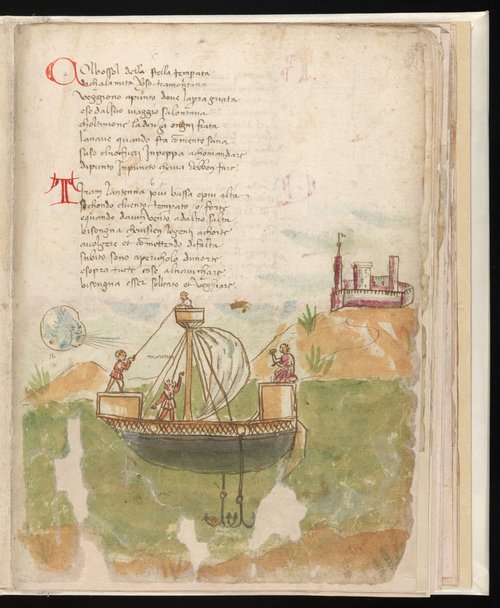
In the twelfth and thirteenth centuries, the commercial revolution in Italy brought economic and cultural change as new trade practices spread from port towns into inland cities. Citizens of Pisa, Genoa, and Venice engaged heavily in overseas trade, organizing themselves into trading companies with several members working under one or more directors.
While Italians, Spaniards, Africans, and Easterners had long shared common business practices, the decades around 1300 brought a wave of mercantile innovation: bills of exchange (similar to modern checks), double-entry bookkeeping (recording transactions as debit or credit), and insurance contracts. (Image from UPenn, Kislak Center, LJS MS 27, f. 77v.) Shortly before 1300, Mediterranean seafarers also drew up the first nautical charts (also known as portolan charts), which mapped coastal itineraries and waterways (Figure 3).
Although the Black Death (1347-1350) shrank the demographic and geographic scope of international commerce, Florentine commercial success continued well into the fifteenth century, owing largely to the city’s purchase of Pisa, Livorno, and Porto Pisano in 1406 and 1421. Control of these ports let Florence capitalize on commercial innovations, strengthen their commercial position on a broader international stage, strengthen their city’s international position, and remain a powerful trading force well into the 1450s. The Florentines started regular galley sailings to Alexandria and Constantinople in the 1420s and 1430s, and even established trading relations with the Ottomans after Constantinople fell in 1453.
But Florentine success also depended on business acumen. Because international trade demanded substantial practical knowledge, merchants compiled trade manuals on routes and navigation, currency exchange, or the weights and measures used in various ports. Some also included travel reports, price lists, mathematical texts, maps, and personal recollections. Handbooks often paired general information with specific cultural or geographical advice about particular locales, and they might list tradeable products or offer tips on how to recognize quality merchandise.
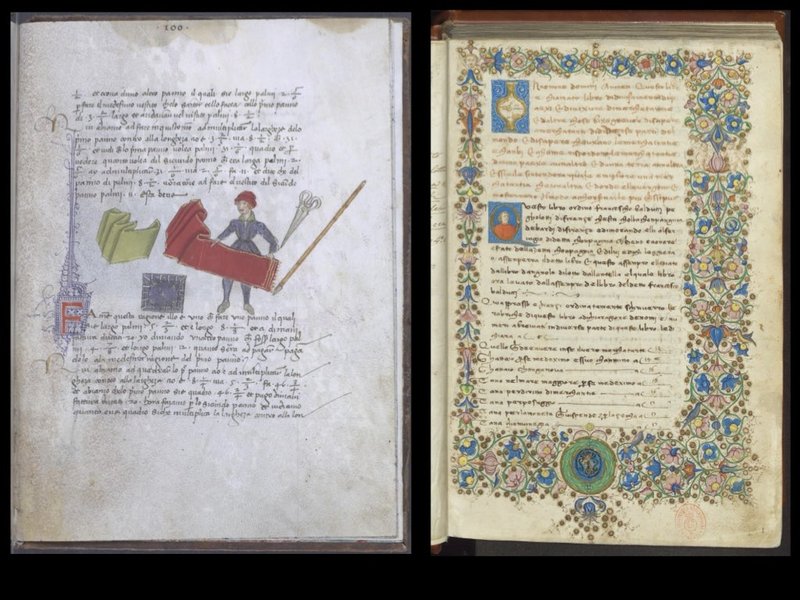
Here are two such merchants' manuals copied in the 1470s: the Algorismus, an anonymous textbook of practical math (left, showing a math problem involving cutting a bolt of cloth), and the so-called Pratica della mercatura of Francesco Balducci Pegolotti (right). Pegolotti (c. 1310–40), a Florentine merchant like Dati, describes in his treatise the regions that merchants most needed to know, such as the Silk Road route to Cathay. He also covers products, measuring systems, currencies, fees, custom duties, expense tables, fairs, and contracts, and even explains how to compute Easter and Lent in distant places.
Likewise, the Florentine Pratica della mercatura by Giovanni da Uzzano (1442) lists the gabelle, or import duties, levied on hundreds of products coming into the main Tuscan cities. Like Pegolotti, Uzzano covers weights, measures, and currencies from many places. And like Books 3 and 4 of Dati’s Sfera, the latter part of his manual reads like a geography lesson, listing distances and travel times between locales, with a chapter on navigation and the Mediterranean’s main winds.
This practical approach also marks other extant merchant writings: letters such as those written between Francesco Datini (the famous Merchant of Prato) and his associates report business conditions in this place or that; diaries reflect thoughts and memoranda written at home or after work; and manuals record norms and accumulated practical knowledge.
Since each book was copied individually, and usually personalized for a single owner, such collections were never definitive but rather always open to additions and personalization. The overall genre, however, would have been well known to Dati and his business partners. Together, these sources reveal shared cultural patterns among the period’s informative or educational texts.
Although it seems odd to us, poetry was common for didactic writings in Florence and beyond, since verse was easier to memorize. In Book 3 of La sfera, for example, the continents’ arrangement as a T in an O—“a drawing with a T inside an O shows / how the world is divided into three parts” (@@.@@.@@-@@)—becomes a powerful mnemonic device, especially when paired with its small world-map diagram (see Figures 4 & 31) [Figure 4 near here]. Merchant writers like Dati were attuned to the world of information surrounding their trade and drew widely from cosmological, scientific, and geographic sources in their works.
Literary Influences
The poem’s stanzas are octaves rhyming ABABABCC, a metrical pattern known in Italian as ottava rima. This was not an obvious choice. Didactic poems written in Italian during the late fourteenth and early fifteenth centuries typically followed Dante’s Divine Comedy, whose interlocking tercets (terza rima) suited the continuous development of an argument. Ottava rima, by contrast, was primarily used for narrative, especially chivalric romances and epics such as Boccaccio’s Filostrato (1335), Ariosto’s Orlando furioso (ca. 1507–32), and Tasso’s Gerusalemme liberata (1581). In Dati’s Florence, people of all classes could also hear professional singers perform cantari, tales told in ottava rima about devout saints, errant knights, and foreign princesses. Dati may have chosen the form to lend his teachings excitement and frame his overview of the world as an adventure. Above all, however, ottava rima let him divide his material into units readers could easily digest and memorize, with each stanza typically treating a single topic or region.
Most manuscripts reinforce this structure with subheads known as rubrics, often written in red ink in the margins of each copy. These were probably devised by Dati himself as they summarize each stanza: those on solar and lunar eclipses, for example, are titled “Obscuring of the Sun” and “Obscuring of the Moon” (1.26, 1.28). Some rubrics also teach rhetoric: “Salutation,” “Invocation,” and “Prologue” divide the opening of Book 1 according to the conventions of premodern grammar and poetry textbooks, such as the ars dictaminis and ars poetriae (rules prescribed for beginning poems, speeches, and sermons).
For Dati, La sfera’s pedagogical goals were entwined with a desire to invite his readers to frame their personal experiences within a Christian understanding of the world. The poem contains many references to Christian belief and biblical history. For example, the itineraries in Books 3 and 4 mention numerous Christian pilgrimage sites or locations related to biblical episodes such as Noah’s Ark, the Tower of Babel, and the Holy Sepulcher in Jerusalem. This had also been the approach taken by most medieval cartographers, whose goal was more to present the history of Creation within the geography of God’s created world than to assist people in moving from point A to point B. Mapmaking was therefore imagined as a form of historiography or even hagiography, with the map—and therefore the world itself—functioning as a form of historical text or chronicle. In fact, the southeastern Mediterranean had been firmly under Mamluk control for decades by the time Dati penned his poem, the Ottoman empire was quickly expanding, and neither of the popes who ruled during Dati’s life—Martin V and Eugenius IV—managed to unite Christian leaders in a new crusade to gain control of Jerusalem.
Dati’s self-fashioning as a poet also proceeds primarily through a religious lens. The poem opens with a sequence of six invocations framing the work as divinely inspired, five of which translate psalms into the Florentine vernacular. His requests to God, “open my lips… let me announce your ways… come to my aid” (1.2), are verbatim citations from Psalms 50, 25, and 69. These psalms belonged to the daily offices found in books of hours, the personal prayer books of the period, and they would have been well known to the literate upper class.
Dati and Dante
In the stanza’s last two lines, however, Dati also hopes his words may benefit those willing to read them. To express this, he rhymes costrutto (“argument” or “discourse”, denoting speech as organized logical exposition) with frutto (“fruit” or “product”). Neither the word nor the pairing is casual: Dante used costrutto several times in the Divine Comedy, popularizing it as a term for the articulation of discourse. As a fifteenth-century Florentine, Dati probably owned a copy of the Comedy, heard it performed in the city’s piazzas, and may have known it, or parts of it, by heart. After the Bible, it was the first text he would have turned to for ideas about how to write literature and how to write about it. Reading La sfera alongside the literature cherished by the mercantile class of fifteenth-century central Italy thus clarifies Dati’s position within the multidisciplinary knowledge base on which the poem draws.
Dati’s intimate knowledge of Dante also helped him situate his Florentine readers within the space the poem describes. Of Tunis, in Book 4, Dati writes that “this city is so closely aligned with Florence / that they nearly share sunset and sunrise” (4.8.3–4). In other words, the two cities lie on the same longitude, so the sun rises and sets at about the same time in both. The image comes directly from Dante’s Paradiso 9, where Folquet de Marseille describes his hometown’s alignment with Bugia, a port on the North African coast, in the same terms. Just as Folquet aligns Marseille with Bugia, Dati anchors Tunis to Florence, helping readers orient themselves in a world where Florence is the center and the point to which one always wishes to return. Yet the poem never describes Florence, the Italian peninsula, or Western Europe; they remain an unstated center toward which its network of trading routes and ports ultimately points.
Alongside the Bible, Dante was the source through which world history entered La sfera. When Dati notes in Book 4 that ancient Troy lies on the coast of modern-day Turkey, his account of the city’s end (“where the great destruction / of proud Ilium occurred, when it was set afire,” 4.27.6–7) once again echoes the Divine Comedy (citation needed). Readers would have recognized the citation instantly, and it would have helped them commit the rest of the stanza to memory. Indeed, almost every manuscript that maps this section places a burning city labeled “Troy” on the coastline (Figure 5); some illustrators depict no city at all but simply an angry red blaze. In these manuscripts, as in Dati’s poem, history is constantly replayed through memory, and Troy is always burning and in ruins.
La sfera was written as a guide for Florentine merchants navigating travel and trade at the dawn of the fifteenth century. At the same time, it offers its readers an intellectual compass for understanding their place in the world. This orientation is rooted in a Christian view of the cosmos and of life on Earth, reflecting the beliefs and devotional practices of premodern Europe, and it takes Florence as its geographical and cultural focal point. To this end, Dati combined two traditions: the pedagogical texts that taught Florentines cosmology, astronomy, and geography, and the growing body of poetry in the Florentine vernacular. The latter ranged from revered works such as Dante’s Divine Comedy, which offered a prestigious model to emulate, to the widely performed ottava rima adventure narratives known as cantari. Together, these traditions allowed Dati to shape his teaching into a form his audience would find familiar, engaging, and easy to memorize.
Cosmology and Astronomy
While La Sfera is remarkable for its mercantile perspective on the Mediterranean Sea and its coastal cities, Dati places his description of Mediterranean travel within a typical medieval cosmology. In Books 1-3, Dati describes the cosmos as it was understood in the later Middle Ages, that is, as a geocentric (Earth-centered) universe composed of concentric, invisible spheres.
These ideas can be traced back to the writings of Claudius Ptolemy (d. 170 CE), an astronomer and cartographer from Roman Egypt and the author of the Almagest, an astronomical manual written c. 150 CE (Figure 6). Ptolemy’s work was in turn a refinement of the theories of Aristotle as described in De caelo (On the Heavens, ca. 350 BCE). In the Ptolemaic system, the earth stands still at the center of the universe (earth being the heaviest of the four classical elements), while the rest of the universe revolves around it in circular motions, following regular paths on invisible spheres (Figure 15). This model of the universe dominated cosmology and astrology until the innovations of Copernicus, Galileo, and Kepler in the sixteenth and seventeenth centuries.
The most popular medieval account of these ideas was De sphaera mundi, a Latin treatise written c. 1230 by Johannes de Sacrobosco. By Dati’s time, however, Sacrobosco’s work had been synthesized into a number of vernacular treatises written by Tuscan and Florentine authors, for example Ristoro d’Arezzo’s 1282 Composizione del mondo (The Composition of the World), Zucchero Bencivenni’s translation of Sacrobosco into Italian ca. 1300, or Brunetto Latini’s Tresor (1260–67). Although written in French, Latini’s poetic Tresor circulated widely in Italy, France, and the Mediterranean; the French had been translated into Italian before the end of the thirteenth century, and it remained a foundational text through which readers like Dati learned about the cosmos. Ptolemaic cosmology was therefore easily accessible to late medieval Florentines like Dati who may not have had a formal Latin education. In La sfera, Dati took the cosmological, astronomical, and geographical knowledge collected in these earlier works and presented it in a form that appealed to audiences of his own day.
The Ptolemaic system divides the cosmos into three regions. Starting from the earth at the center of the universe and going outward—heaviest to lightest—these are, first, the sublunary spheres of the elements: earth, water, air, and fire; and second, the planetary spheres of the Moon, Mercury, Venus, the Sun, Mars, Jupiter, and Saturn (1.12–25; Figures 16–19). Beyond the planets was the circle of the fixed stars, including the twelve constellations of the Zodiac, while the outermost sphere was the Primum Mobile (“prime mover”), whose highest heaven, the Empyrean, was believed to be the seat of God. (In Dati’s time, the sun and moon were included among the seven planets because they follow different paths from the “fixed stars” of the constellations.)
According to medieval astrology, the movements of these spheres—including the planets and the constellations—influenced personalities, health, and inclinations, while also shaping prosperity and struggles, successes and disasters for humankind more broadly (Sfera 1.33–34; see also the next section on the humors). Dati also discusses solar and lunar eclipses, the phases of the moon, and the effects of the moon on all living beings. Earth, located at the center of the model delineated by Dati (2.6), is shaped like a sphere or globe, which provides the title for Dati’s book: La sfera. (Sfera could actually be translated here as “globe”, “sphere”, “world”, or “earth”.) Dati argues that a portion of the sphere is visible when you look at the horizon: if you “imagine you are on a high mountain / looking all around in every direction: / the sky will appear to you like the arch of a bridge, / set upon the earth like an oven. / The circle around the edge is the horizon” (2.18.1–5).
Furthermore, astronomy is one of the arts of the quadrivium, the medieval curriculum encompassing the four liberal arts concerned with number and ratio: arithmetic, geometry, music, and astronomy. Arithmetic and geometry were especially important for merchants and sailors, for example when calculating the celestial positions of planets and stars. Dati explains in Book 1 how people traveling by sea can find north using a reference star, the North Star or Polaris. While the North Star appears to stand still, every other star seems to move around it, tracing a circle in the sky (1.7; Figure 13); additionally, at night one should have “the star of the compass tempered / by a magnet to point north,” so that “sailors can see precisely where the prow of the ship points” (3.5).
Geometry combined with knowledge of the winds allows sailors to maintain their heading at sea and to enter harbors safely. While the classical system named twelve winds, most medieval compass roses divided the compass into “eight winds for sailing” (3.2; Figure 28). Dati categorizes winds as whole, half, or quarter winds, and he distinguishes them based on cardinal points and strength to produce a more detailed list of up to twenty-four winds total (3.2–9).
The Human Body and the Humors
For Dati, the universe (the macrocosm, or “big cosmos”) and the human body (the microcosm, or “little cosmos”) mirrored each other in organization and function: each is composed of the four elements (fire, air, water, earth) and shaped by the four elemental qualities: hot, cold, wet, dry. These are discussed in Book 2, which introduces the four elements and discusses their influence on the geographical, seasonal, and climatic features of the globe (2.1–25; Figures 20–24) as well as the human body and soul (2.26–36).
According to medieval philosophers, the human body is defined not only by these elements and their qualities, but also by the four humors or bodily liquids of blood, phlegm, yellow bile, and black bile. These were first described by the ancient physicians Hippocrates and Galen, whose writings and ideas formed the basis of learned medicine in the medieval world. The doctrine of the humors states that every person’s health is determined by the relative balance or imbalance of the four humors within their body.
In most people, one dominant humor determines their complexion: their overall state of health, body shape, appearance, susceptibility to disease, and even personality. The four major complexions were sanguine (blood), phlegmatic (phlegm), choleric (red bile or choler), and melancholic (black bile), described by Dati at 2.27–32. Furthermore, an excess or corruption of one of the humors can lead to physical or mental illness. A melancholic person, for example, has an abundance of black bile, which means they are likely to be “pale, thin, and joyless” and subject to quartan fevers (fevers that recur every fourth day). A small but noteworthy group of twelve La sfera manuscripts includes painted figures or vignettes depicting allegorical figures of the planets and/or these humoral categories, characterizing the typical sort of person who is “sanguine”, “choleric”, and so forth (Figures 8 and 9, also 27).